


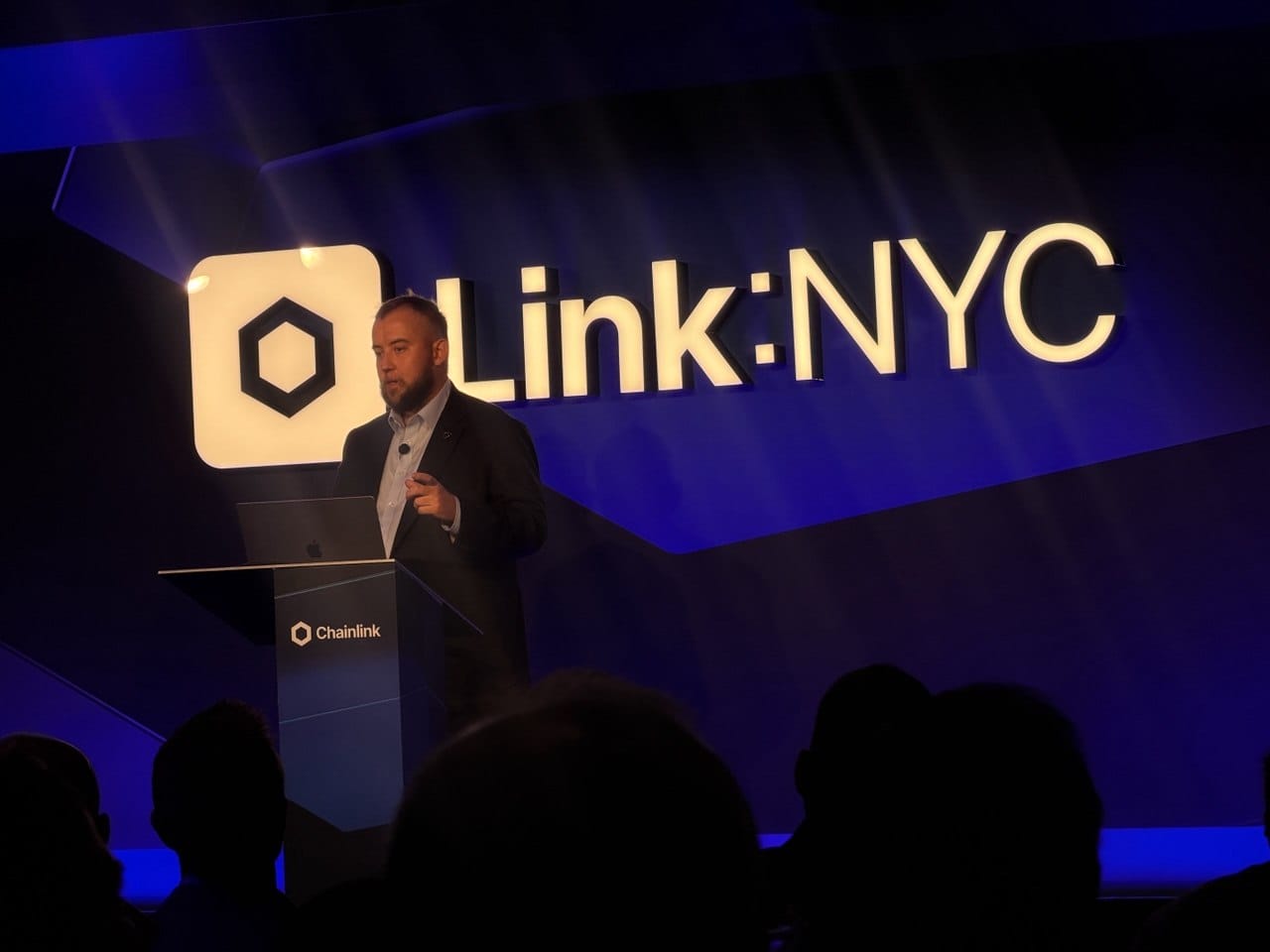
During Chainlink’s premier Link:NYC event, Chainlink co-founder Sergey Nazarov reflected on the year’s biggest advancements in building the financial system of the future.
He harkened back to Chainlink’s longstanding mission to power a global financial system built on immutable onchain golden records.
“This is what I understand the new global financial system to be. It’s this new method of recordkeeping that redefines how everyone relates to each other in transactions. It expands the ability for transactions to work – not only in developed markets, but also in emerging markets. And it solves fundamental systemic financial risk issues.”
Having enabled over $36 trillion in transaction value, Chainlink is the largest provider of critical infrastructure for golden records that represent lending and credit onchain.
“Chainlink’s goal as an infrastructure has been to make all these increasingly valuable onchain records work properly from the perspective of data, compliance, interoperability, and now privacy and orchestration,” Nazarov explained.
“Fundamentally, we are seeking to take all the onchain records, whether they’re traditional finance or decentralized finance, and make them operate correctly and expand what they do.”
He believes the theme of this year’s Link:NYC is how Chainlink can power greater utility.
“How do you enable utility for tokenization beyond just tokenization? That is the key question. After you’ve tokenized something, there has to be utility. There has to be a reason why that tokenized thing is superior to the traditional asset.”
Nazarov said economic benefits such as 24/7 collateral management and access to global liquidity make lending and credit tokenization’s “killer” application.
This year, Chainlink has been focused on building end-to-end solutions such as CustodySync, which allows institutions to access onchain liquidity while keeping their assets in custody. By synchronizing custodial systems with onchain lending protocols, CustodySync aims to unlock institutional capital that has historically remained inaccessible to decentralized markets.
Chainlink also recently introduced Chainlink Fulcrum for institutional financing and collateral management across public and private blockchains. Fulcrum provides a single gateway for global financial institutions to maximize the utility of tokenized assets through the multi-chain ecosystem without locking them into any one venue.
Fulcrum leverages multiple Chainlink services, including the Chainlink Runtime Environment (CRE) for orchestrating transaction lifecycles, Cross-Chain Interoperability Protocol (CCIP) for cross-chain data and asset transfers, and Data Streams for collateral valuation data.
“It’s really not possible to do advanced transactions without all these components that Chainlink has,” Nazarov said.
While the existing financial system consists of many different siloed systems, tokenization strives to bring all assets onchain where they are completely interoperable.
“The complexity of getting them to interact with each other is the problem we’re solving.”
At the heart of interoperability is CCIP 2.0, the latest evolution of Chainlink’s Cross-Chain Interoperability Protocol (CCIP), which allows institutions to securely distribute compliant tokenized assets across multiple private and public blockchains without rearchitecting their existing systems.
As the only interoperability solution to meet ISO 27001 and SOC 2 Type 2 institutional security standards, CCIP’s blockchain-agnostic, neutral architecture is the foundation for tokenizing $867 trillion worth of assets onchain.
“Our goal is to make sure that this level of connectivity and interoperability happens – that all of the different venues, chains, tokenized assets, and data sources interoperate correctly; that they are able to do transactions in a reliable, useful way; and that those transactions provide real value and utility to tokenized assets beyond just the process of tokenization,” Nazarov said.
“If we can achieve this, it will redefine our industry to be the place that powers the new global financial system.”