


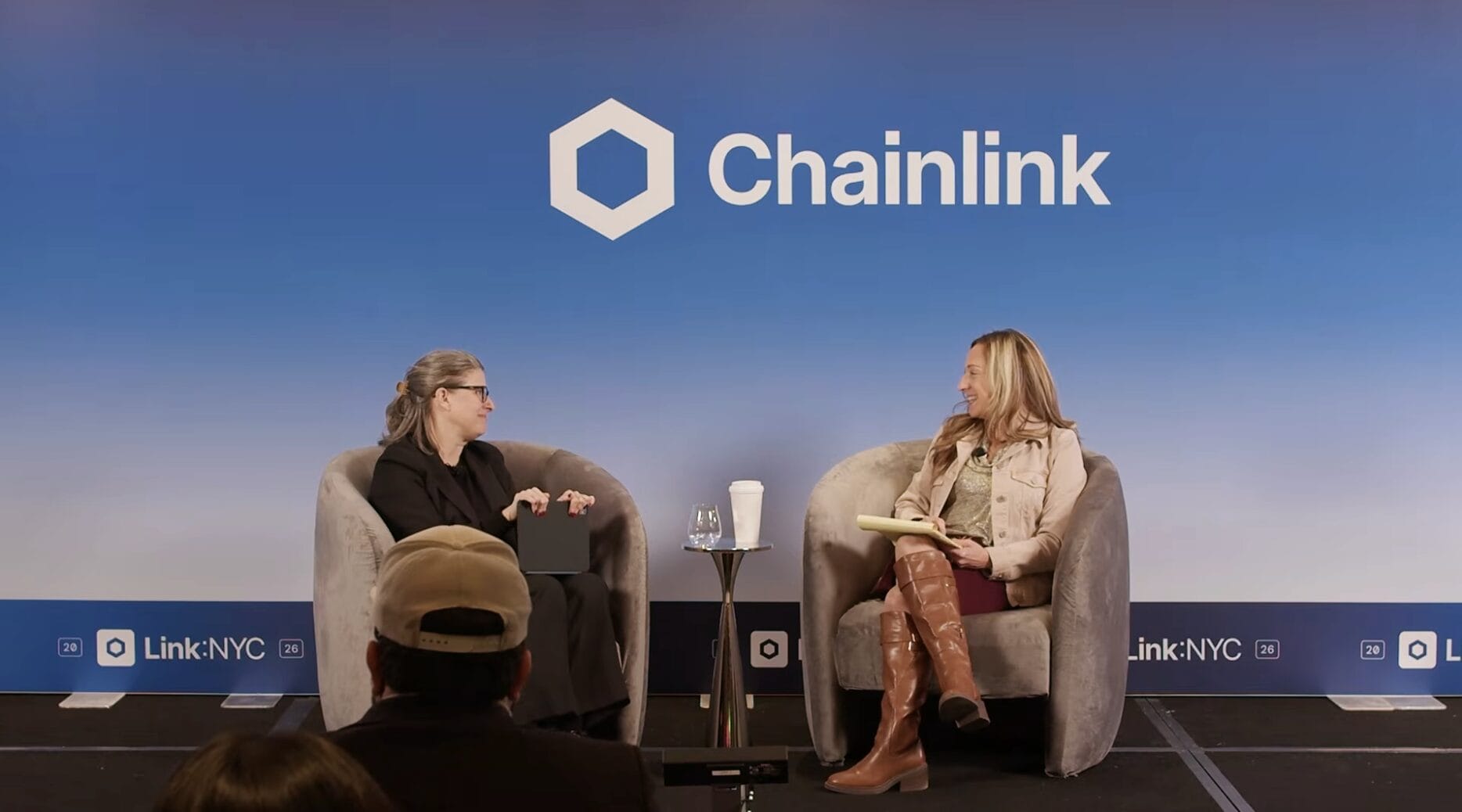
During Link:NYC, Jennifer Lassiter, Head of Digital Assets, Europe and Americas at Standard Chartered, sat down with Jill Malandrino to discuss why companies are seeking stablecoins, how shared standards unlock cross-border markets, and why collateral is the next breakthrough in tokenization.
Standard Chartered is a global multinational bank that provides financial services in more than 50 markets across Asia, Africa, the Middle East, Europe, and America. Standard Chartered’s ongoing collaborations with Chainlink and other major global financial institutions aim to establish standardized onchain frameworks for data, identity, and compliance in order to reduce transaction and coordination costs for institutional digital assets.
Most recently, Standard Chartered was among 17 banks to pilot test a connectivity framework for global financial institutions to access Swift’s blockchain ledger using the Chainlink Runtime Environment (CRE). The self-signing solution allows banks to seamlessly execute 24/7 cross-border payments and manage smart contracts using tokenized deposits.
Lassiter explained how stablecoins unlock the full potential of tokenized assets by facilitating institutional borrowing, lending, and cross-border transactions. Clients aren’t simply seeking out stablecoins – they want the solutions stablecoins offer.
“It’s like a hallelujah moment where we’re finally talking about the problem we’re trying to solve,” she said.
Corporations want the benefits of digital assets without turning into crypto companies. They’re looking to free up trapped liquidity and maximize real-time settlement while their bank manages the technical complexity and risks associated with moving money cross-chain.
“This is about connecting the movement of money with the speed of the internet,” Lassiter said.
As the only interoperability solution to meet ISO 27001 and SOC 2 Type 2 institutional security standards, Chainlink’s Cross-Chain Interoperability Protocol (CCIP) is being adopted by leading DeFi applications as well as traditional banks and financial institutions for cross-chain, cross-border asset and information transfer.
“You can’t move across borders if you don’t have technical standards,” Lassiter explained.
“Tokenization is just the movement of data in a way that’s recognized across borders, and that’s where you see the efficiency. If you don’t do that right, you’ve essentially built domestic systems in silo of each other and that’s really not helpful.”
Ultimately, institutions are interested in the added utility tokenization brings to traditional assets. For example, a tokenized money market fund can be used as collateral while the underlying shares remain in regulated custody.
“That actually makes your money start to work for you and that’s meaningful,” Lassiter said.
She believes collateral will be the next major breakthrough in tokenization.
“You’ve got something that’s really slow and clunky today, but very critical to the broader financial system. Looking at how tokenization is used within collateral is where we certainly are focused as we’re looking across the next six months.”
Watch the full conversation.