


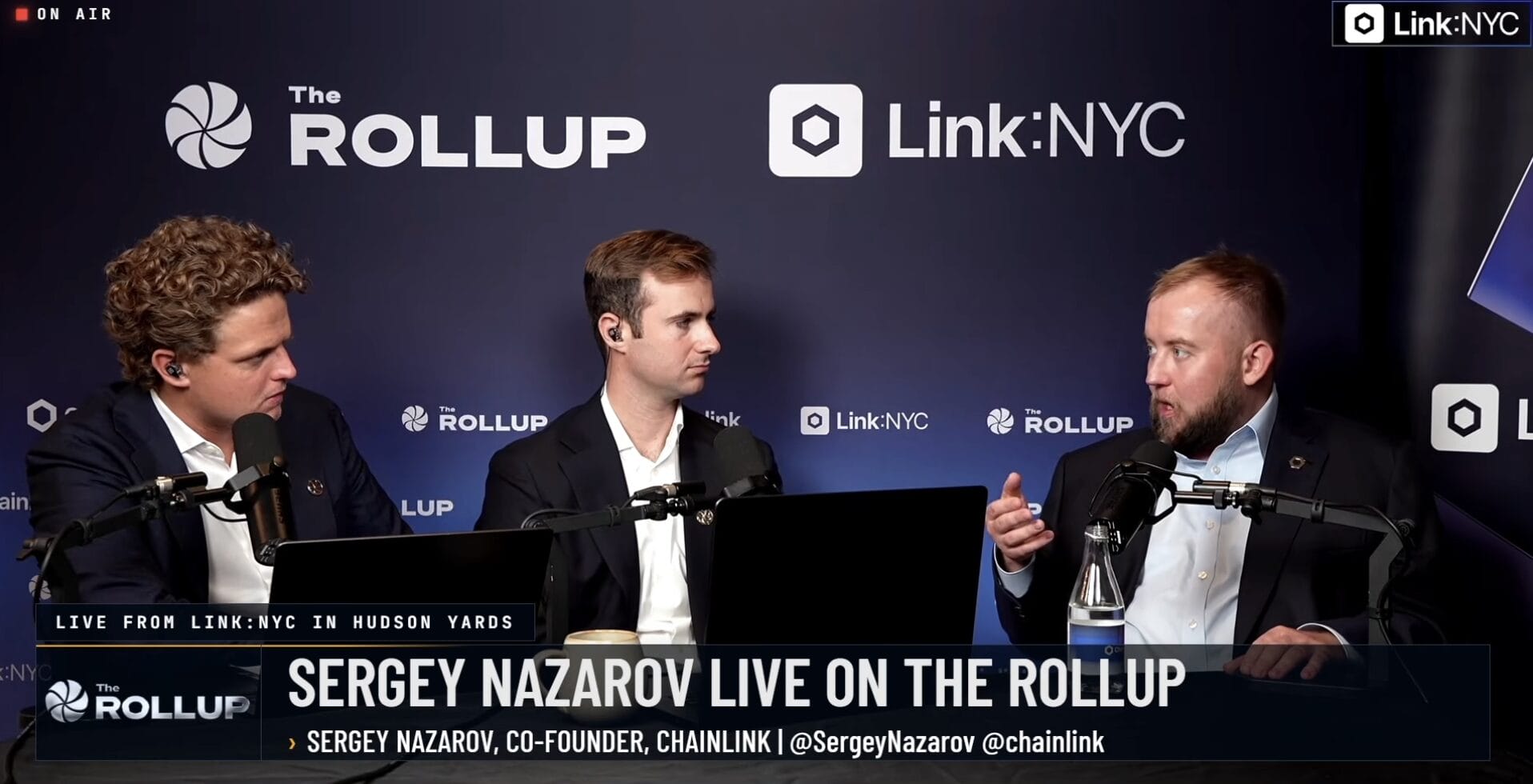
During Link:NYC, Chainlink co-founder Sergey Nazarov joined hosts Andy and Robbie live on The Rollup to discuss why 24/7 markets need 24/7 data, how Chainlink enables cross-border flows that connect global capital to U.S. assets, and his vision for the agentic economy.
24/7 markets was a hot topic at Link:NYC, where Chainlink launched Chainlink 24/7, a market data solution that facilitates continuous trading, lending, and risk management for tokenized real-world assets (RWAs) across blockchains. The solution delivers around-the-clock pricing data for stocks, commodities, and other traditional assets, extending market coverage to weekends and holidays.
“You need tokenization to create an onchain financial product or asset that’s better than the traditional version,” Nazarov explained.
“And for that to be true, you need 24/7.”
To provide 24/7 data, Chainlink aggregates multiple different data sources using session-aware stitching, which manages transitions between pricing sources as market sessions change. The solution fulfills one of the basic promises of the blockchain industry: 24/7/365 markets.
“A lot of things happen over the weekend,” he said.
“You could be completely wrecked just because the infrastructure doesn’t allow you to do anything on the weekend.”
Chainlink is also focused on allowing as much TradFi capital as possible to flow onchain. Nazarov believes TradFi will continue to custody assets, providing “a certain level of security guarantees” their users depend on.
“There needs to be more money coming in always in order for the public blockchain, the crypto industry, and the RWA industry to succeed,” he said.
Chainlink’s CustodySync connects qualified digital asset custodians with DeFi lending markets, allowing institutions to access onchain liquidity while keeping their assets in custody. Already adopted by Anchorage Digital, the first federally chartered digital asset bank in the United States, the solution makes it possible to use custodied digital assets as collateral without transferring them out of existing custody arrangements.
“There’s a mirrored version of the asset that’s generated on the chain where you want that asset to be used in a DeFi protocol. That means that users of custodians like Anchorage and others can now utilize their assets in DeFi without having to leave the security of that custodian.”
Bringing global custodians onchain using the Chainlink standard creates the opportunity for traditional assets to move as seamlessly as crypto across different chains throughout the world.
“Bitcoin is globally dispersed, usable, and accessible from the day it began; that’s the point and that’s not true for traditional finance,” Nazarov said.
“There is a lot of pent-up liquidity and demand in the Middle East, in Asia, in all kinds of places that can’t access each other’s assets on traditional rails, including accessing U.S. assets, U.S. equities, or U.S. funds. The tokenization trend and the blockchain trend is a real opportunity to completely rethink that.”
Chainlink’s infrastructure, particularly Cross-Chain Interoperability Protocol (CCIP), makes these cross-boarder transactions possible by cryptographically guaranteeing a transaction cannot fail according to specific predetermined conditions.
Chainlink isn’t just building the standard for DeFi and TradFi – it’s also building the most attractive solution for AI agents. Chainlink’s essential orchestration layer, the Chainlink Runtime Environment (CRE), is built to allow agents to utilize different DeFi protocols and chains the same way an engineer would.
Nazarov described how a future version of CRE would expand its capabilities specifically for AI according to human-controlled conditions for how agents are able to interact with DeFi and RWAs.
“I definitely see CRE being a preferred environment for agents,” he said.
“The widest breadth and greatest depth of what they can do onchain will be through CRE.”
Watch the full conversation.