


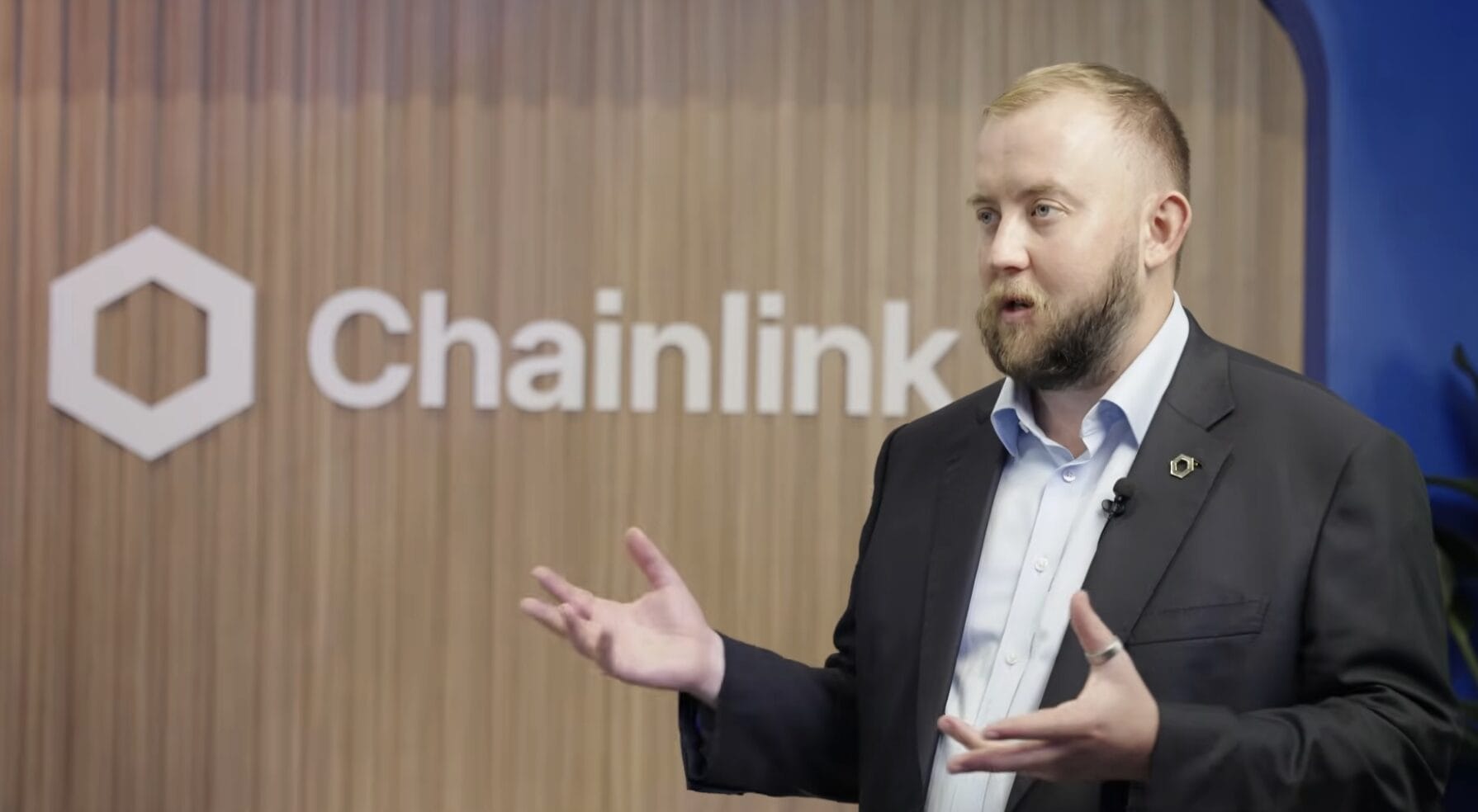
During Sibos 2026, Chainlink co-founder Sergey Nazarov sat down with FinTech BoostUP to talk about the impact of Chainlink’s recent announcements and the most significant topics at this year’s event.
Last week, Chainlink launched CCIP 2.0, the latest evolution of its Cross-Chain Interoperability Protocol. CCIP 2.0 allows institutions to distribute tokenized assets between private and public blockchains according to rigorous standards for security, compliance, and speed, without the need to rearchitect their existing systems.
“It really adds those key TradFi features, which are the ability to configure compliance at a very granular level and the ability to build your own bridging networks,” Nazarov said.
CCIP 2.0 is deeply integrated with the Chainlink Runtime Environment (CRE), which large institutions such as DTCC are leveraging to power complex smart contracts for collateral management and loan obligation.
Chainlink also introduced Chainlink Fulcrum, an end-to-end solution for institutional financing and collateral management across public and private blockchains. Fulcrum provides a single gateway for global financial institutions to maximize the utility of tokenized assets through the multichain ecosystem without locking them into any one venue.
“It simplifies how the institutional user interacts with all the collateral venues, lending protocols, and all the other systems they need to interface with in order to actually get useful value from the tokenized equity, tokenized cash, and tokenized funds through these more advanced agreement types such as securities lending and repo,” Nazarov explained.
During Sibos, Chainlink and DTCC demonstrated how DTCC’s Collateral AppChain will leverage CRE and the Chainlink data standard to support near-real-time collateral management across financial markets and blockchains.
“DTCC is providing a never-before-seen blockchain environment that creates legally binding ownership and real tokenization of equities,” Nazarov said.
He explained how Chainlink supercharges the Collateral AppChain’s impact by enabling accurate pricing, collateral movement, payment and repayment of loan obligations, and yield creation.
“All of this is really needed to make tokenization useful, because tokenization in and of itself just puts something on a chain.”
A new Chainlink connectivity framework allows global financial institutions to access Swift’s blockchain ledger using CRE. The self-signing solution allows banks to seamlessly execute 24/7 cross-border payments and manage smart contracts using tokenized deposits.
“It allows you access to the Swift ledger as a reliable solution for signing or where you can plug in your various other signing solutions,” Nazarov said.
“This should accelerate the adoption of the Swift ledger and it should make Chainlink and CRE a widely adopted form of interfacing to the Swift ledger.”
Ultimately, he believes this year’s Sibos marked a turning point in the conversation about the role of digital assets and AI in global finance.
“Tokenization is now an accepted trend that is viewed only positively and one that everyone has to build around. And there are a lot of conversations about how AI usage of tokenized cash, tokenized payments is going to change micropayments and how a lot of payments work. Chainlink has a big role to play in both of those things.”
Watch the full interview.