


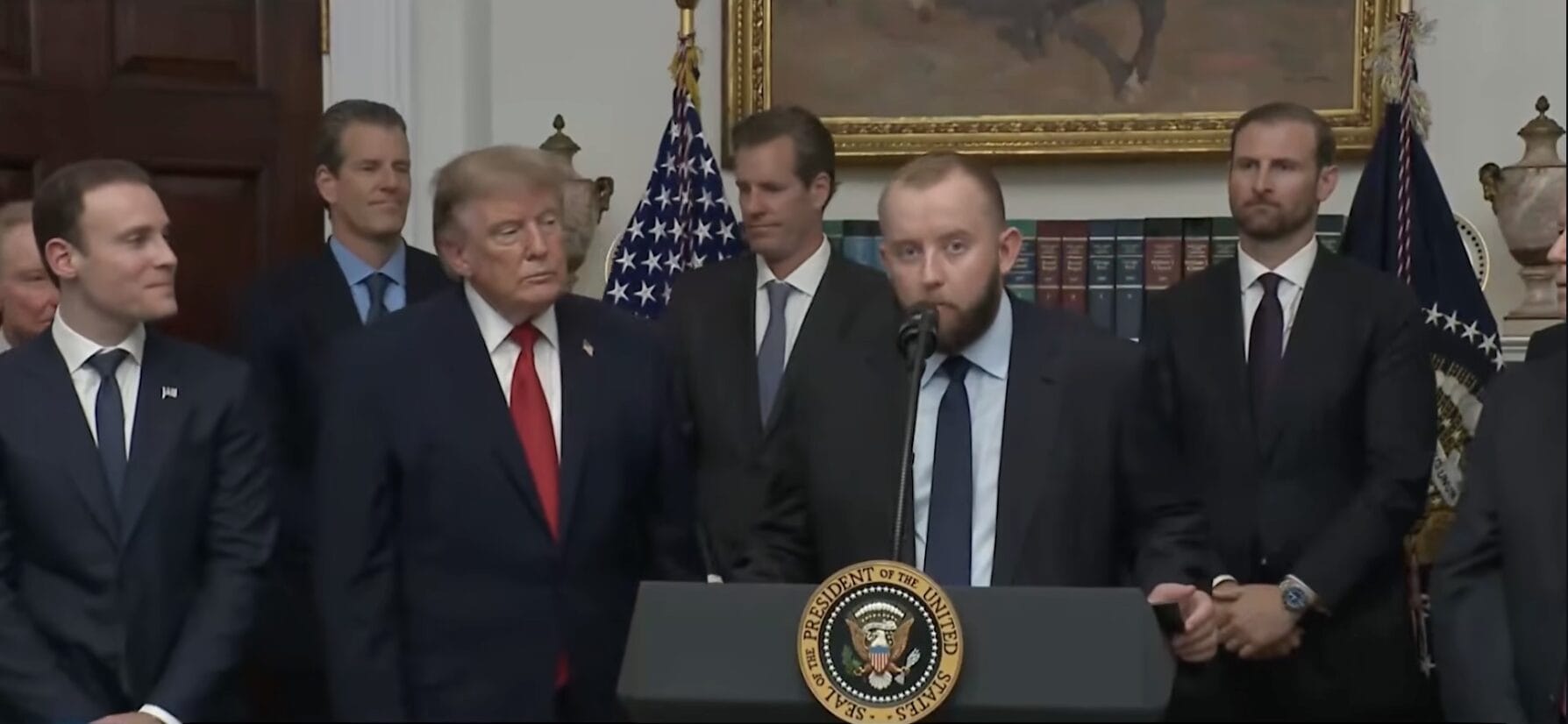
This week at the White House, Chainlink co-founder Sergey Nazarov addressed tokenization’s impact on the American economy.
“There’s a very real and tangible outcome that’s benefiting the adoption of U.S.-issued assets and the U.S. dollar.”
Nazarov highlighted the collaborative effort between CFTC Chairman Michael Selig and SEC Chairman Paul Atkins to establish transparent frameworks for digital asset markets and support technological advancement that drives global distribution.
“What Chairman Selig and Chairman Atkins are doing and the President has enabled with his leadership is actually working.”
Nazarov was at the White House when the GENIUS Act, which established the first federal guardrails for U.S. dollar-pegged stablecoins, was signed into law last year. He said the landmark bill has since driven stablecoin usage to “higher levels than our industry has ever seen.”
After the SEC released its 2026 Agency Rule List with 23 proposed rules that would make it easier to tokenize real-world assets in the United States, Nazarov met with Chairman Atkins and key policymakers at the White House to outline the advantages of using smart contracts to set conditions around compliance, identity, and transferability.
Earlier this year, Nazarov was appointed to the CFTC’s Innovation Advisory Committee (IAC), to provide feedback on how decentralized oracle networks create secure, reliable onchain markets and how the U.S. can position itself as a hub of innovation for cryptocurrency, DeFi, and digital assets.
A 2025 White House Digital Asset Report highlights Chainlink’s essential role in the digital asset economy. Having enabled over $33 trillion in transaction value, Chainlink powers the vast majority of DeFi and is utilized by major financial institutions such as Swift, Euroclear, UBS, Wellington Management, ANZ, and Fidelity International. In an increasingly global economy, Chainlink’s 24/5 U.S. Equities Streams unlock the $80 trillion U.S. stock market onchain.
“We power a lot of these applications and companies so we know what the numbers actually are and they’re massively increasing,” said Nazarov.
“It really is working and hitting all-time highs.”