


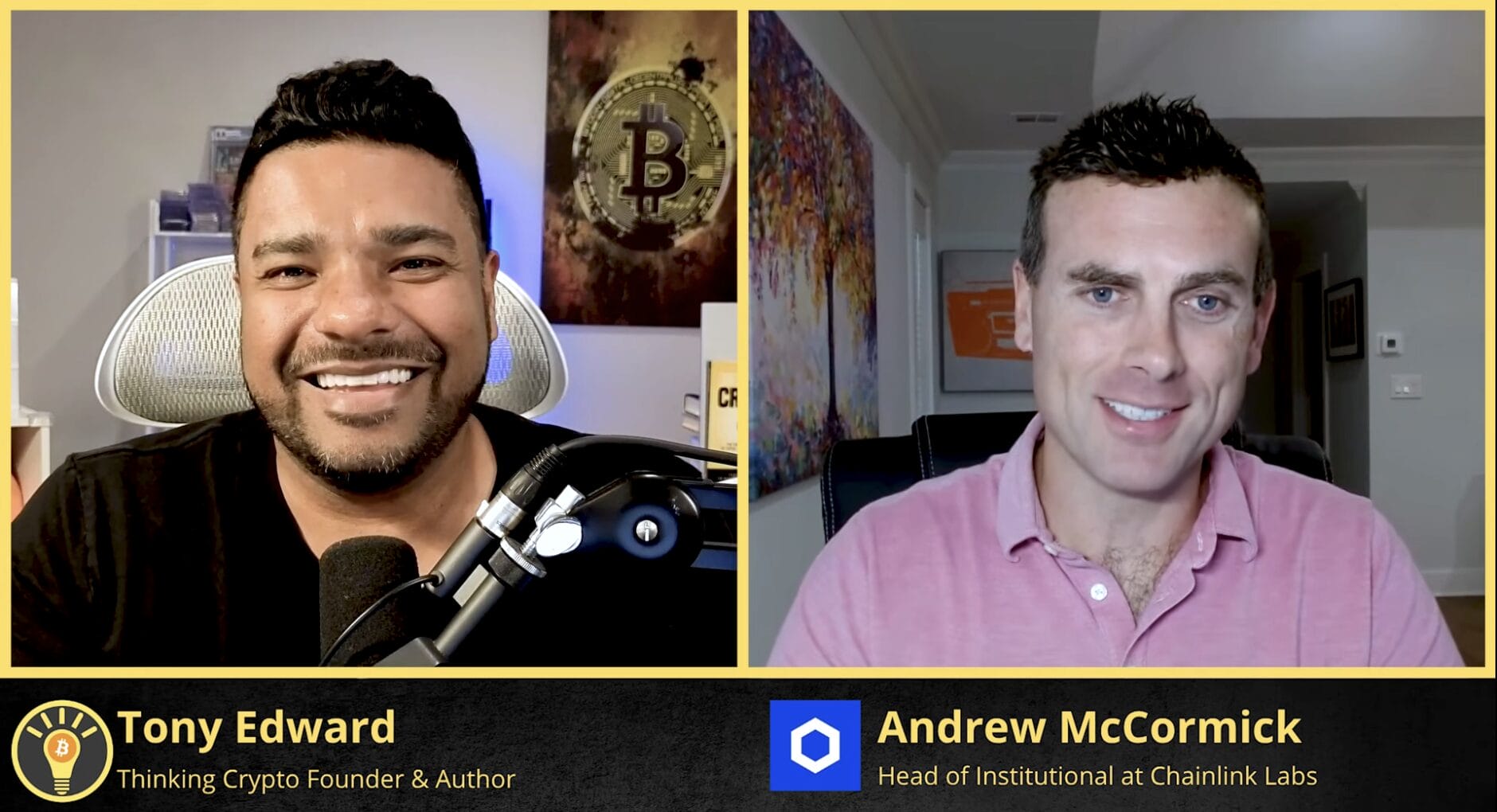
Andrew McCormick, Head of Institutional and Market Development at Chainlink Labs, recently joined Thinking Crypto podcast host Tony Edward to talk about how major institutions are leveraging Chainlink to tokenize assets and bring traditional financial markets onchain.
McCormick said Chainlink’s industry-standard oracle platform is bridging the gap between the existing system and the growing multi-chain economy.
“We are the connection between blockchains and the real world.”
During Sibos 2026, Chainlink launched CCIP 2.0, the latest evolution of its Cross-Chain Interoperability Protocol (CCIP), with launch partners including Fidelity International, AWS, and Google Cloud. CCIP 2.0 allows institutions to securely distribute compliant tokenized assets across multiple private and public blockchains without rearchitecting their existing systems.
Key features include user-operated Cross-Chain Verifiers (CCVs) for additional verification, built-in compliance functionality for enforcing internal risk and regulatory requirements, and customizable speed settings that can be configured to support near-instant transfers or maximize security.
“It’s the same security with more adaptability,” McCormick explained.
“You can tailor it how you want. The idea also is to tailor it once and then you can repeat it.”
Chainlink also recently introduced Chainlink Fulcrum, an end-to-end solution for institutional financing and collateral management across public and private blockchains. Fulcrum provides a single gateway for global financial institutions to maximize the utility of tokenized assets through the multi-chain ecosystem without locking them into any one venue.
“Fulcrum is Chainlink’s move into the world of collateral,” McCormick said. “Collateral is that killer use case blockchain has been waiting for.”
According to Citi, idle institutional collateral amounts to roughly $346 million in forgone revenue for the average Tier 1 firm each year. Tokenized assets have the potential to unlock institutional capital at scale, but only if they can be put to use across markets without platform lock-in or bespoke integrations.
Once lenders and borrowers agree on terms, Fulcrum records the loan onchain, manages collateral, and coordinates cross-chain settlement, updating records and automating the loan lifecycle.
“All the typical protections are there; it’s just automated communication through Fulcrum,” McCormick explained.
“No one has to hit a green button to liquidate the asset. It’s happening automatically.”
He reiterated Chainlink’s goal is not to destroy the existing financial system, but to put it on better, more efficient rails. He believes this will ultimately benefit all participants in the global economy.
“My hope and dream is that everything we do when working with institutions is ultimately benefiting mainstream retail investors,” he said.
“I think the same collateral management idea will absolutely apply to retail, and has applied to retail, and certainly can unlock a lot of good there too.”
Watch the full conversation.