


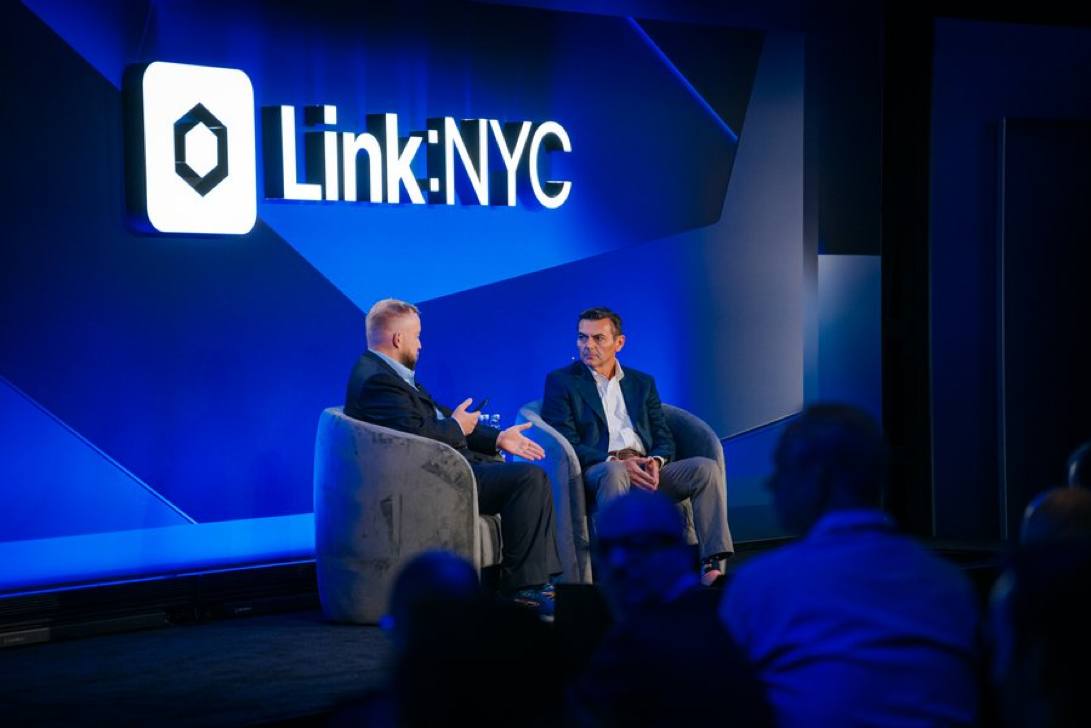
During Link:NYC, Chainlink co-founder Sergey Nazarov sat down with DTCC CEO Frank La Salla for a fireside conversation about how tokenized securities and 24/7 collateral movement can unlock billions in trapped liquidity and transform how capital moves around the world.
DTCC is the primary financial market infrastructure for U.S. capital markets. Created over 50 years ago to dematerialize securities and electronify transactions, DTCC currently settles and clears $20 trillion, or two-thirds of the U.S. GDP, every day.
“We maintain the integrity of the ledger for the entire industry,” La Salla explained.
“Our mandate is to be a conductor of traffic.”
In May, DTCC announced the creation of Collateral AppChain, a shared blockchain infrastructure designed to streamline near-real-time movement, valuation, and settlement of tokenized collateral across global markets.
AppChain leverages Chainlink’s data standard and the Chainlink Runtime Environment (CRE), a universal orchestration layer for building end-to-end institutional-grade smart contracts and bringing hundreds of trillions in tokenized assets onchain.
Announced last year as part of DTCC’s Great Collateral Experiment, AppChain provides a unified onchain environment where investors can unlock trapped assets and optimize their use across counterparties and time zones.
DTCC’s tokenized equities are the gold standard because they are digital twins of traditional equities with the same legal rights and investor protections. This is because DTCC tokenizes entitlement representing a traditional security position that is already held in custody by the Depository Trust Company (DTC), a subsidiary of the DTCC Tokenization Service.
“One of our first principles was that we do not want to issue a receipt of the underlying security,” La Salla explained.
“We want the tokens to have the same legal entitlements as the securities that we are holding for the industry.”
Nazarov called this distinction “a foundational thing that allows tokenized equity to be taken seriously.”
As capital markets continue to grow, financial institutions are becoming more capital- and liquidity-constrained. La Salla highlighted how blockchain is perfectly suited to solve costly inefficiencies in collateral management, ultimately freeing up billions of dollars in liquidity while reducing risk.
“There is not enough cash in the universe to settle gross. There isn’t. And it gets back to the need for balance sheet relief and liquidity relief. We’ve got to solve that on the blockchain.”
DTCC built its private, permissioned AppChain on Hyperledger Besu. Integrating Chainlink allows AppChain to access critical real-time data as well as connect with other public and private chains throughout the growing multichain ecosystem.
“One of the major things that Chainlink helped us with was that interoperability layer and that is crucial to our success,” La Salla said.
“The other value that you brought to the table was you allowed us to scale interoperability, because we’re in the midst of a number of L1s and they are proliferating.”
Nazarov agreed that interoperability is the key.
“Together, our goal is to resolve that problem so that it’s not a problem, it’s not an issue, and this isn’t even a consideration when you’re thinking of how to transact or whether to transact. It’s just a solved problem that has a back-end solution and that’s it.”
Watch the full conversation.