


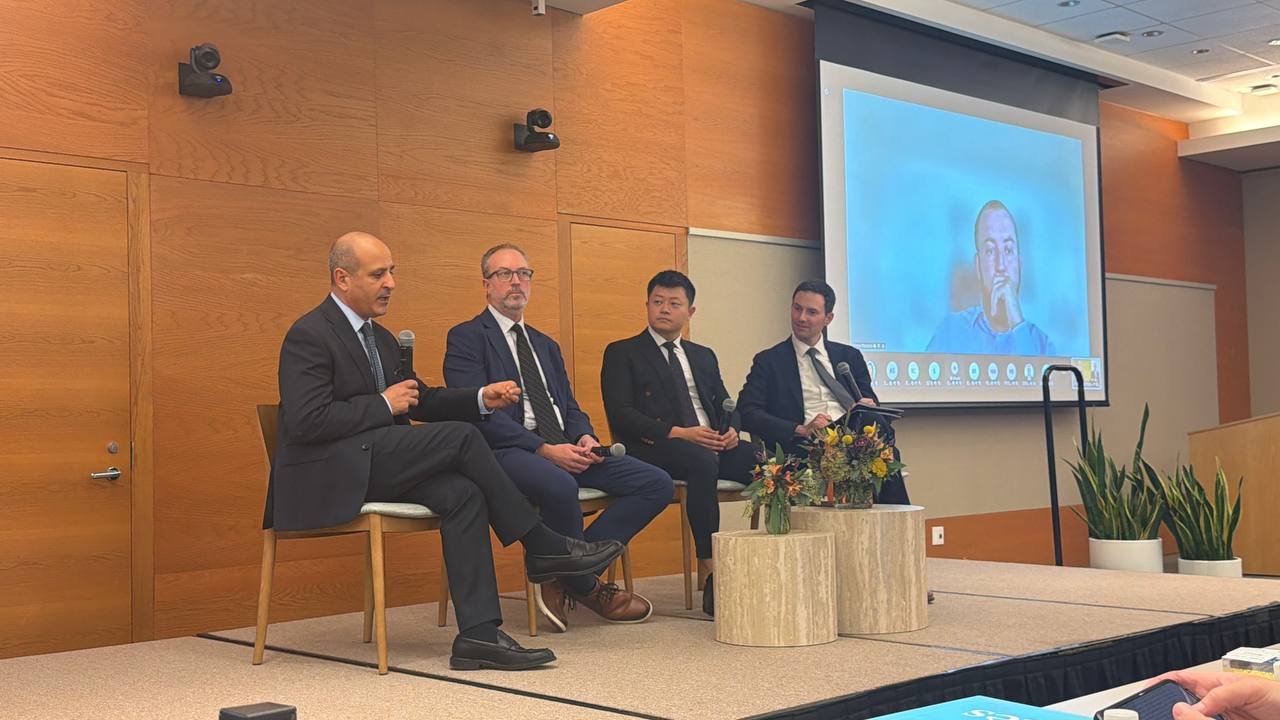
This week at the Federal Reserve Bank of Philadelphia, Chainlink co-founder Sergey Nazarov joined BlackRock’s William Su, Vanguard’s John Evans, Sharplink’s Joseph Chalom, and Atlantic Council’s Josh Lipsky for a panel on “The Future of Blockchain in Traditional Finance,” which explored the infrastructure required to bring institutional assets onchain at scale.
Having recently returned from the UAE, BlackRock’s Su described “significant demand and interest” in tokenized real-world assets (RWAs).
“Yield in this region and in a lot of parts around the world – the demand is extremely high and what they’re looking for is higher-quality real-world assets,” he said.
Having enabled over $34 trillion in transaction value, Chainlink’s comprehensive oracle services have established the standards for creating and securing RWAs throughout their entire life cycle across multiple chains, regions, and regulatory environments.
Su highlighted the recently launched gold-backed, yield-bearing PAXGy token, which leverages Chainlink Price Feeds and Cross-Chain Interoperability Protocol (CCIP), as an in-demand RWA.
“Enabling lending and collateral on digitized gold is a really important addition to that pool. I think we’ll see more of that to come.”
Last week, the SEC approved an Innovation Exemption granting a temporary, five-year framework to allow onchain trading of tokenized U.S. equities. Despite the Clarity Act’s failure to advance in the Senate, Nazarov is optimistic that the SEC’s rulemaking will create market dynamics that foster permanent change.
“Now things are going to move at lightning speed for the regulatory process. Clarity would have made that even faster, but it’s still going to be a very fast pace, and that’s going to result in a lot of exciting market events like tokenization of equities.”
He expects this momentum will persist beyond the current administration.
“This exemption will result in enough adoption and growth and usage of, in this case, tokenized equity in the markets that removing it will be painful.”
As the costs of setting up and executing cross-chain transactions are “dropping like a stone,” Nazarov anticipates a proliferation of banks creating tokenized deposit issuance and management chains.
“If their treasurers can now get yield on that money, and they can move that money cheaper and faster, and they can do international settlement with that money cheaper and faster, the real question is why wouldn’t they do it?”
Chainlink’s Automated Compliance Engine (ACE) solves the high-cost, high-friction barriers to cross-border transactions by codifying different regulatory systems into smart contracts.
“This is actually going to create massive advantages for the transactions that happen onchain, because they’ll be able to resolve those questions much more quickly and much more efficiently than the current system,” Nazarov said.
“The current system is like squeezing water out of a stone – you’ve been squeezing it for 50, 60 years – how much more incremental improvement are you really going to get?”
Ultimately he expects bringing the global financial system onchain through stablecoins and RWAs will reinforce the U.S. dollar’s role as the world’s dominant reserve currency.
“There’s actually a symbiotic relationship there, where the more financial products go onchain, the more the U.S dollar can do onchain, the more U.S. dollars go onchain, and the more useful the U.S. dollars are onchain.”