


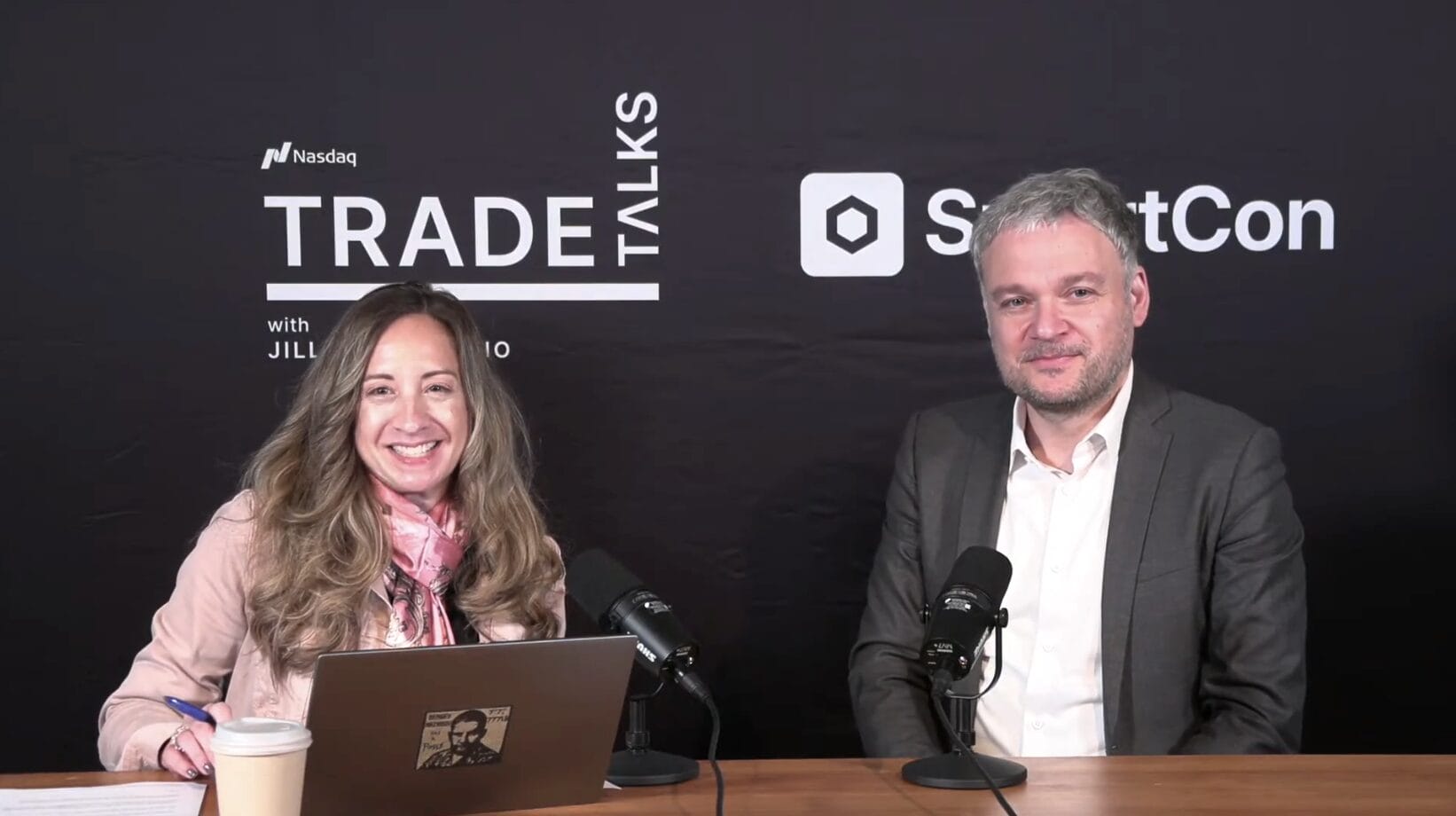
SmartCon 2025 featured presentations from more than 100 web3 pioneers and financial leaders, who gathered to highlight the theme,“From Crypto to Capitol Hill.” To delve deeper into the most groundbreaking topics from this year’s event, Nasdaq TradeTalks’ Jill Malandrino interviewed some of the most influential speakers on-site at Manhattan’s Metropolitan Pavilion.
Fernando Vazquez is President of Capital Markets at Chainlink Labs, the primary contributing developer of Chainlink. He sat down with Malandrino to discuss what it takes for institutions to fully embrace tokenized financial products.
“People realize that a tokenized format is more efficient than what we’ve seen for equities in the past,” he explained.
“You have a single golden source of truth that helps with distribution of market data with corporate actions. You don’t need to reconcile after the fact; everything’s on the same chain.”
Beyond efficiencies such as programmability and composability, tokenized assets unlock a new realm of utility.
“You can do something with it,” Vazquez said. “You can send a tokenized fund or security to a DeFi protocol and borrow stablecoins against it. You can send that to a prime broker to trade at Coinbase and eventually at Fidelity or any other broker.”
Chainlink recently announced a ready-to-use solution for global financial institutions to manage digital asset workflows using the Chainlink Runtime Environment (CRE) and the Chainlink Digital Transfer Agent (DTA) alongside their existing systems and Swift messaging standards. The first use case involved UBS Tokenize, the tokenization unit of UBS Asset Management, one of the world’s largest private banks with over $6 trillion in assets under management.
“One of the things that we’ve shown by doing live transactions with partners like UBS is that this is actually workable, that it was end-to-end,” Vazquez explained.
“Beyond that, we proved that you don’t need to change everything overnight. You can keep using your traditional payment rails. We proved you can organically grow into a tokenization or token-powered financial ecosystem. It’s not about disruption.”
While the U.S. provides greater regulatory clarity around digital assets, Vasquez said Chainlink is providing the core infrastructure institutions need to tokenize assets onchain.
“As a regulated institution trying to get into this space, you need to follow regulations, you need compliance and, for certain use cases, you need privacy. Chainlink is building all those building blocks – the data primitives, the cross-chain communication primitives, but also the privacy and compliance.”
Watch Jill Malandrino’s full interview with Fernando Vazquez.